- 35.1 billion euros in GDP, 481,600 jobs and 20.6 billion euros in tax revenue in 2024
- Germany and Italy each account for 23 percent of the total economic output
- Exports fell by 22 percent in 2025, the trade deficit almost doubled
How big is the motorcycle industry as an economic factor in Europe? The European manufacturers’ association ACEM commissioned the research institute Oxford Economics to take a fresh look at this question. The results were presented for the first time during EICMA 2026 in Milan, at a conference called MOTONOMICS. The figures refer to the year 2024 and cover the 27 EU member states plus the United Kingdom. They paint the picture of an industry that has grown considerably, but is under growing pressure. The trade data for 2025, which the association analysed in addition, is particularly sobering.
How much is the motorcycle industry in Europe worth?
In 2024, the motorcycle industry contributed 35.1 billion euros (around 39.4 billion US dollars) to gross domestic product in the EU and the UK. On top of that come 481,600 jobs and tax revenue of 20.6 billion euros (around 23.1 billion US dollars).
To make the scale tangible, the study’s authors draw two comparisons. The economic output is higher than Iceland’s entire GDP. The tax revenue would be enough to pay the annual salaries of around 460,000 teachers in Europe.
Which areas count as part of the motorcycle economy?
The largest share comes from the core of the industry: building, selling and repairing motorcycles and parts. This area accounts for 26.7 billion euros (around 30.0 billion US dollars) and 356,700 jobs, roughly three quarters of the total impact. Helmets, motorcycle clothing and protective gear add 5.7 billion euros (around 6.4 billion US dollars) and almost 89,000 jobs. Races, trade shows and manufacturer events contribute a further 2.7 billion euros (around 3.0 billion US dollars) and 36,000 jobs.
How many jobs depend directly on motorcycles?
208,900 people work directly in the industry, from the factory to the dealer to the workshop. The remaining jobs are created indirectly, for example at suppliers or because employees and event visitors spend their money. The industry itself directly generates 10.6 billion euros (around 11.9 billion US dollars). That is more than European manufacturing of communications equipment.
Experts call this the multiplier. It shows how much additional economic output depends on every euro generated directly. According to the study, every euro from the motorcycle industry supports a further 2.30 euros in other sectors of the economy. Every direct job secures an additional 1.3 jobs outside the industry. In manufacturing, sales and repair, 46 percent of the value added is created at suppliers.
What role does Germany play in the European motorcycle economy?
Together with Italy, Germany is one of the two most important locations. Each of the two countries accounts for 23 percent of the industry’s total economic output in Europe.
They are followed by France with 13 percent, the UK with 9 percent, Spain with 7 percent and Austria with 5 percent. Together, these six countries account for around four fifths of the impact. In terms of jobs, Germany is just behind Italy with 20 percent compared to 22 percent, and in terms of tax revenue Germany reaches 21 percent. Looking only at the industry’s direct economic output, Germany is even in the lead with 24 percent.
Germany also plays a major role when it comes to trade shows and manufacturer events. With 626,000 visitors, Germany accounted for 25 percent of all guests at such events in Europe. Intermot 2024, with 100,000 visitors, was the second-largest motorcycle show after EICMA.
What has changed since the last motorcycle study?
The figures are significantly higher than those of the previous study, which Oxford Economics published in 2021 using data from 2019. Back then, the industry came to around 21.4 billion euros in GDP, about 389,000 jobs and around 16.6 billion euros in tax revenue. The multiplier was 1.80 euros per directly generated euro.
However, the two studies cannot be compared one to one. The authors point out that the data and the calculation model have improved since 2019 and that the industry is now captured more completely. They attribute part of the growth to changes since the pandemic. Back then, many people discovered the motorcycle as a means of transport for themselves. Despite the decline after the switch to the Euro 5+ emissions standard, new registrations in the largest markets in 2025 were still 14.7 percent above the 2019 level.
The study also cites the growing number of low-emission zones in European cities, which favour small and economical vehicles. Rising prices for new and used cars also make motorcycles and scooters more attractive for newcomers. After the pandemic and the war in Ukraine, many manufacturers are also relying more heavily on suppliers from Europe, which keeps more value added in the region.
Why are exports from European motorcycle manufacturers falling?
Exports from the EU fell by 22 percent to 2.0 billion euros (around 2.2 billion US dollars) in 2025. The main reasons are a production stop lasting several months at Austria’s largest manufacturer and several tariff increases by the USA.
Before that, the industry had become increasingly focused on foreign markets. In 2024, around half of the motorcycles and parts built in the EU were exported, compared with 43 percent for vehicles in 2019. Exports of 2.5 billion euros (around 2.8 billion US dollars) were offset by imports of 3.5 billion euros (around 3.9 billion US dollars) in 2024. The most important customer was the USA with 761 million euros (around 854 million US dollars).
Because trade conditions changed significantly after 2024, ACEM added the figures for 2025. While exports fell, imports rose by 12 percent to 3.9 billion euros (around 4.4 billion US dollars). The trade deficit thus grew from around 1.0 to 1.9 billion euros (around 2.1 billion US dollars).
Around three quarters of the drop in exports can be traced back to Austria, where the most important motorcycle manufacturer had largely halted its production between mid-December 2024 and the end of July 2025. Exports to the USA collapsed by 40.3 percent to 455 million euros (around 511 million US dollars). Even excluding Austria they fell by 21.7 percent, from Germany by 18.9 percent and from Italy by 24.8 percent. Motorcycles over 800 cc, actually a strength of European manufacturers, were hit particularly hard. Here, a surplus of 290 million euros in 2024 turned into a small deficit.
How fast is competition from China growing?
Imports from China rose by 32.1 percent to 1.05 billion euros (around 1.18 billion US dollars) in 2025. The share is growing particularly quickly for larger motorcycles over 250 cc, in other words exactly in the classes where European manufacturers have their strengths.
In 2019, motorcycles of this size from China still had an import value of 93 million euros. In 2025 it was 610 million euros (around 685 million US dollars). The number of units rose from around 111,000 to 190,000 in 2025 alone. This means that 32 percent of all imported motorcycles over 250 cc now come from China, almost as many as from Japan with 33 percent. Chinese motorcycles are imported at a much lower value. Over 800 cc, the average value was 4,776 euros, compared with 7,906 euros for Japanese models.
What do motorcycles bring to city traffic?
There are 42 million motorcycles on Europe’s roads, which is 11 percent of all motorised vehicles. Every day, 6.4 million people ride a motorcycle to work.
According to the study, their travel time is a third shorter than by car. Each motorcycle commuter saves around 580 euros (around 651 US dollars) a year. A motorcycle needs 2.9 square metres to park, a car 11.5 square metres. This means four motorcycles fit into one car parking space. Motorcycle commuters already avoid around 2.4 million tonnes of CO₂ per year compared with the car.
The study also calculates what would happen if 5 percent of car commuters switched to the motorcycle. Together they would save 28 million days of travel time a year, equivalent to a value of 8.6 billion euros (around 9.7 billion US dollars), plus 3.9 billion euros (around 4.4 billion US dollars) in operating costs. Europe would save 2.6 million tonnes of CO₂, and cities would free up 124 square kilometres of parking space. That is equivalent to more than 17,000 football pitches. Experience from a congested motorway in Belgium suggests that a 10 percent switch could reduce traffic jams by up to 40 percent.
How important are racing, trade shows and motorcycle tourism?
More than 5 million spectators attended major motorcycle sports events in Europe in 2024. Together, races, trade shows and manufacturer events secured 2.7 billion euros in economic output and 36,000 jobs.
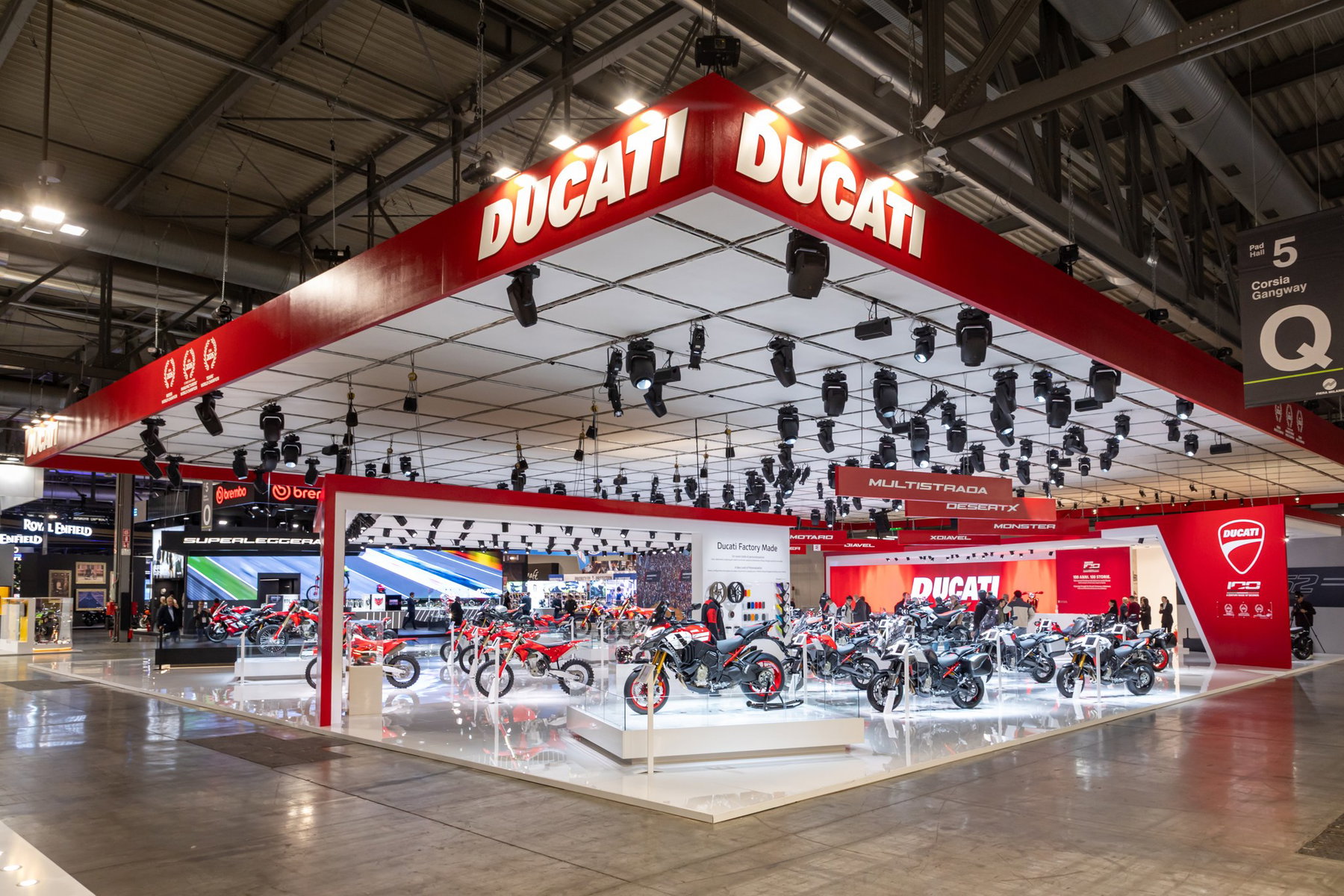
The largest single event was EICMA in Milan with 700,000 visitors. Hotels, restaurants and towns around the circuits also benefit from races and trade shows, because visitors spend money there.
Some areas could not be quantified by the study at all. These include motorcycle tourism, which brings income above all to rural regions, as well as rider training, insurance and delivery services. The authors therefore describe their results as conservative. The actual contribution is likely to be even higher.
What does the motorcycle industry want from politicians?
The manufacturers are calling for fair and reciprocal access to global markets, a firm role for motorcycles in urban transport planning and conditions that allow further investment in Europe. These demands were presented at the MOTONOMICS conference, which ACEM and the Italian industry association Confindustria ANCMA jointly hosted during EICMA 2026.
ACEM Secretary General Antonio Perlot, who presented the study, made it clear that the good figures cannot be taken for granted. Mariano Roman, President of Confindustria ANCMA, spoke about the fact that more new registrations do not automatically lead to more production and higher profits. He called for clear and appropriate rules, reciprocity in trade and full recognition of two-wheelers in transport policy.
ACEM President Markus Flasch, head of BMW Motorrad, also gave a first preview of the association’s new Vision 2035+. It focuses on the competitiveness of the industry, and the programme is due to be presented in early 2027. Member of the European Parliament Pierfrancesco Maran, chair of the Environment Committee of the European Parliament, stressed the benefits of motorcycles and scooters for cities and called for an industrial policy that keeps production in Europe competitive.
The closing panel discussion included, alongside Flasch and Perlot, Ducati CEO Claudio Domenicali, Mariano Roman and Antonio Erario from the Italian Ministry of Transport. The focus was on Europe’s competitiveness, above all the growing competition from China, as well as future regulations for the industry.
Frequently Asked Questions
-
How big is the motorcycle industry as an economic factor in Europe?
In 2024, the motorcycle industry contributed 35.1 billion euros to gross domestic product in the EU and the UK. It secured 481,600 jobs and generated 20.6 billion euros in tax revenue. The figures come from a study by Oxford Economics commissioned by the manufacturers’ association ACEM.
-
How many people work in the motorcycle industry in Europe?
208,900 people work directly in the industry, from the factory to the workshop. Together with suppliers and other effects, 481,600 jobs depend on motorcycles.
-
How large is Germany’s share of the motorcycle economy?
Germany accounts for 23 percent of the industry’s total economic output in Europe, the same as Italy. Germany’s share of jobs is 20 percent, and its share of tax revenue is 21 percent.
-
Why have motorcycle exports from the EU fallen?
Exports fell by 22 percent to 2.0 billion euros in 2025. Around three quarters of the decline is due to a production stop at the largest Austrian manufacturer, plus higher tariffs in the USA. Exports to the USA fell by 40.3 percent.