- Ducati is one of around 600 companies Volkswagen is reviewing out of roughly 2,000 holdings
- In 2025 the brand posted revenue of 925 million euros (around 1.08 billion US dollars), an operating profit of 52 million euros (around 60.6 million US dollars) and 50,895 deliveries
- Bloomberg Intelligence puts the enterprise value at about 1.25 billion euros (around 1.46 billion US dollars), while the only known offer so far stands at 2.5 billion euros (around 2.91 billion US dollars)
For months the debate around Ducati consisted of analyst estimates, anonymous tip-offs and statements that neither confirmed nor ruled out a sale. That changed at the beginning of September. First Ducati boss Claudio Domenicali confirmed that the owner is reassessing the holding, then Gernot Döllner became the first group executive to comment publicly. Twice, however, and with a markedly different message.
What did Audi boss Gernot Döllner say about Ducati?
On 7 September Döllner named a window of two to three years, and one day later he explained that Ducati is part of the ongoing evaluation process. On both occasions he stressed that nothing has been decided.
He told the Italian business daily Il Sole 24 Ore on 7 September: „No decision will be taken in the next two or three years.” That sounded like an all-clear and was understood that way in Italy.
On 8 September the same man told the news agency Bloomberg: „Within the Volkswagen Group, we are committed to a disciplined, responsible portfolio management. It’s part of the evaluation process that we’ll also talk about Ducati, but nothing has been decided.”
There is not a word about the time frame in the second statement. A perspective of several years becomes a process that is already running. What changed between the two dates is not publicly known, and neither Audi nor Volkswagen has explained it. It is possible that both were meant, that is, a review now and a decision only in a few years’ time. Nobody has put it that way, though.
What is remarkable about both versions is less what was said than what is missing. For a brand the group absolutely wants to keep, a clear denial would be the obvious route. Instead the responsible board member names Ducati explicitly and places it in a review process. In the summer, Audi had given an Italian prospective buyer a curt reply: „Ducati Motor Holding S.p.A. is currently not for sale”.
Why is Volkswagen reviewing its portfolio of holdings right now?
The group needs money for its restructuring and therefore wants to shrink its portfolio of holdings by around a third. The supervisory board unanimously approved the corresponding plan on 4 September.
The package is called Future Plan 2030. Around 600 of some 2,000 companies are being reviewed for it. It is meant to generate up to 15 billion euros (around 17.5 billion US dollars) in freely available funds. According to the group, the money will go into electric mobility, in-house software platforms and the ongoing restructuring. Around 135 billion euros (about 157 billion US dollars) in investment is earmarked for the years 2027 to 2031. In parallel, some 50,000 jobs worldwide are to go and the model range is to be halved. Together with an earlier programme, the planned reduction therefore adds up to around 100,000 jobs by the end of the decade.
That decision is the actual trigger. The refusal from the summer was thereby rendered obsolete, not because of Ducati, but because of a decision in Wolfsburg. Two days later, Domenicali confirmed in Bologna that the brand is among the holdings being reassessed.
What does the „necessity-to-own” principle mean for Ducati?
Volkswagen only keeps holdings if they are strategically, operationally or legally necessary for the core automotive business. Inside the group this filter is called „necessity-to-own”.
For Ducati that is precisely the critical point. The brand makes money, but contributes neither a vehicle platform nor software to the car business the restructuring is aimed at. A motorcycle manufacturer with its own development, its own production in Bologna and its own racing programme is hard to justify as necessary by that yardstick. Ducati has belonged to the group via Audi since 2012 and, together with Bentley and Lamborghini, forms the so-called Progressive Brand Group.
The group has long been selling
That this is not a busywork exercise by the strategy department is shown by the transactions already completed. On 10 September, Porsche closed the sale of its stakes in Bugatti Rimac and in the Rimac Group. The buyer is a consortium around the New York investor HOF Capital, with around one billion euros (about 1.17 billion US dollars) flowing to Porsche. The Volkswagen Group is therefore completely out of Bugatti.
In June, Volkswagen had already agreed to sell 51 percent of its marine engine division Everllence, for proceeds of around 7.4 billion euros (about 8.6 billion US dollars), since approved by the EU. Audi itself has handed 60 percent of the design house Italdesign to the American company UST, with the remaining 40 percent staying in the group via Lamborghini.
How is Ducati doing financially?
Ducati continues to operate profitably, but the trend is going the wrong way. In 2025 the books showed 925 million euros (around 1.08 billion US dollars) in revenue and 52 million euros (around 60.6 million US dollars) in operating profit, which equates to a return on sales of 5.6 percent.
The year before, it was a good one billion euros (around 1.17 billion US dollars) in revenue and 91 million euros (about 106 million US dollars) in operating profit, so a return of around nine percent. Profit has therefore slumped by almost 43 percent within a year. Unit sales are falling as well: 50,895 motorcycles delivered in 2025, after around 54,500 the year before, a drop of seven percent. Audi names four reasons for this, namely weaker demand, tougher competition and negative effects from exchange rates and US tariffs.
Two further figures explain why Ducati nevertheless remains a small position within the group. Of everything the Audi group turns over, the brand contributes barely 1.4 percent, and around 1.5 percent of operating profit. On top of that comes an internal benchmark: Volkswagen CEO Oliver Blume has set the group a return of nine percent by 2030. Measured against that, Ducati was still exactly on target in 2024 at about nine percent, and clearly below it in 2025 at 5.6 percent.
What is Ducati worth, and how does the 2.5 billion euro offer fit in?
Michael Dean, an analyst at Bloomberg Intelligence, puts the enterprise value at around 1.25 billion euros (about 1.46 billion US dollars) on the basis of comparable companies. The Italian financial firm Patritalia says it has bid 2.5 billion euros (around 2.91 billion US dollars), roughly double that figure.
This gap is the most striking part of the affair. By its own account, Patritalia submitted its offer on 25 June 2026 to the responsible departments at Audi and Volkswagen, in cash and for 100 percent of Ducati Motor Holding. The firm has not so far publicly provided proof that this money exists. Before this episode the company was practically unknown; it has set itself the goal of bringing Italian brands back under Italian control.
It has also announced that under Patritalia only Italian riders would compete for the brand, from Moto3 up to the premier class. To go with it, the company published images of race bikes in Patritalia livery, which were generated by artificial intelligence and are not real photographs. Ducati has won its recent titles with the fastest riders available, regardless of passport. An all-Italian line-up would be a break with that approach.
As long as there is no independent verification, the 2.5 billion euros remain a declaration of intent and not a market price. They do show, however, the order of magnitude a buyer would have to bring to the table.
How is the political response in Italy?
The Italian government stepped in immediately and intends to accompany the process. Industry minister Adolfo Urso spoke to Domenicali by phone as early as 5 September and subsequently let it be known that the government would use all available means so that this national asset can go on celebrating success.
It did not stop at the phone call. The president of the Emilia-Romagna region, Michele de Pascale, is calling for a round table at the ministry and is demanding that the government examine closely who is even eligible as a buyer. Bologna’s mayor Matteo Lepore invited the three metalworkers’ unions Fiom Cgil, Fim Cisl and Uilm Uil to the Palazzo d’Accursio, the seat of the city administration, for 11 September. The head of Fiom also wants to coordinate with Germany’s IG Metall.
Around 1,800 people work at the headquarters in Borgo Panigale. The local press has spoken to some of them: most would be happy with an Italian entrepreneur as owner, they are worried about a Chinese or Indian buyer and about pure financial investors, and they describe the years under Audi as good. In practice that means a buyer needs not only money but also political backing in Italy. That narrows the circle of possible bidders.
What alternatives to a sale is Volkswagen keeping open?
Alongside a full sale, two other routes are being discussed: a partial stock market listing or more independence for Ducati. Both would free up capital without giving up the brand entirely.
With a partial listing, Volkswagen could place a minority stake on the stock market, take in money and retain control. More autonomy would mean Ducati being run more strongly as a standalone unit, which would technically make a later sale easier. There is no bidding process so far, nor any official mandate to look for buyers. Ducati still belongs 100 percent to Audi AG.
How is Ducati itself responding to the review?
Domenicali has confirmed the reassessment while stressing that no final decision has been taken. He commented on 6 September on the sidelines of an event in Bologna.
His quote reads: „We are aware of the shareholder’s plan to reassess its holdings. Ducati is one of these holdings, but there has been no final decision on Ducati yet: it is one of the evaluations ongoing.”
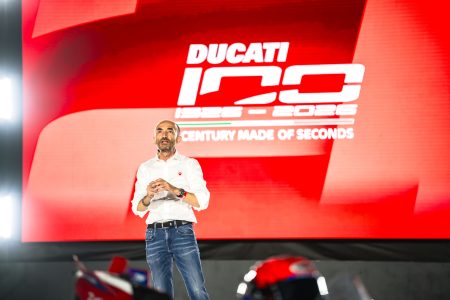
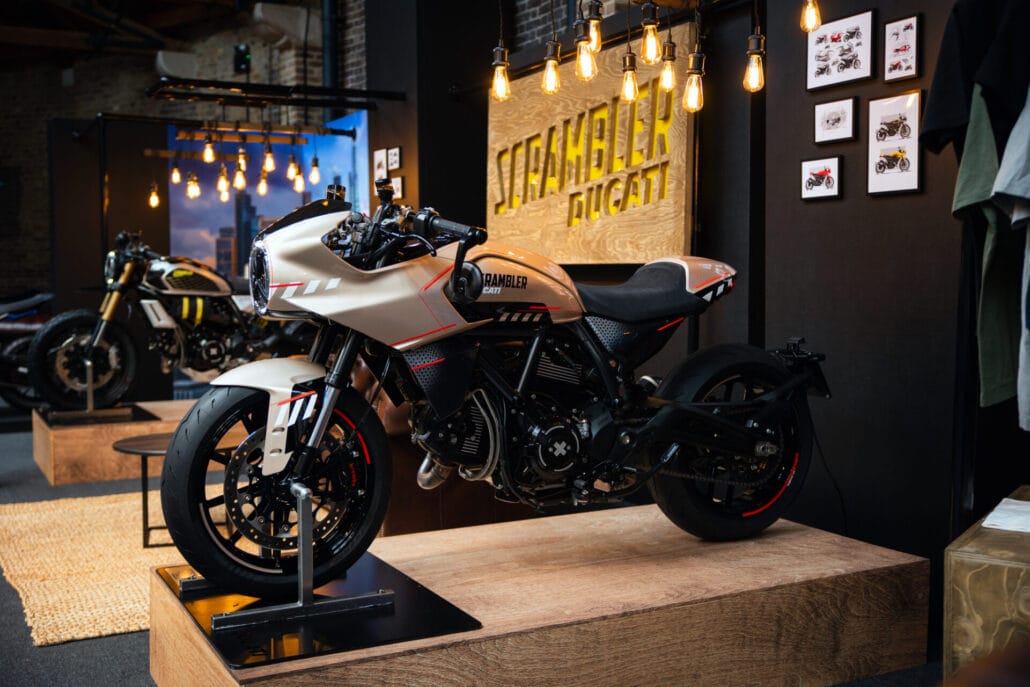
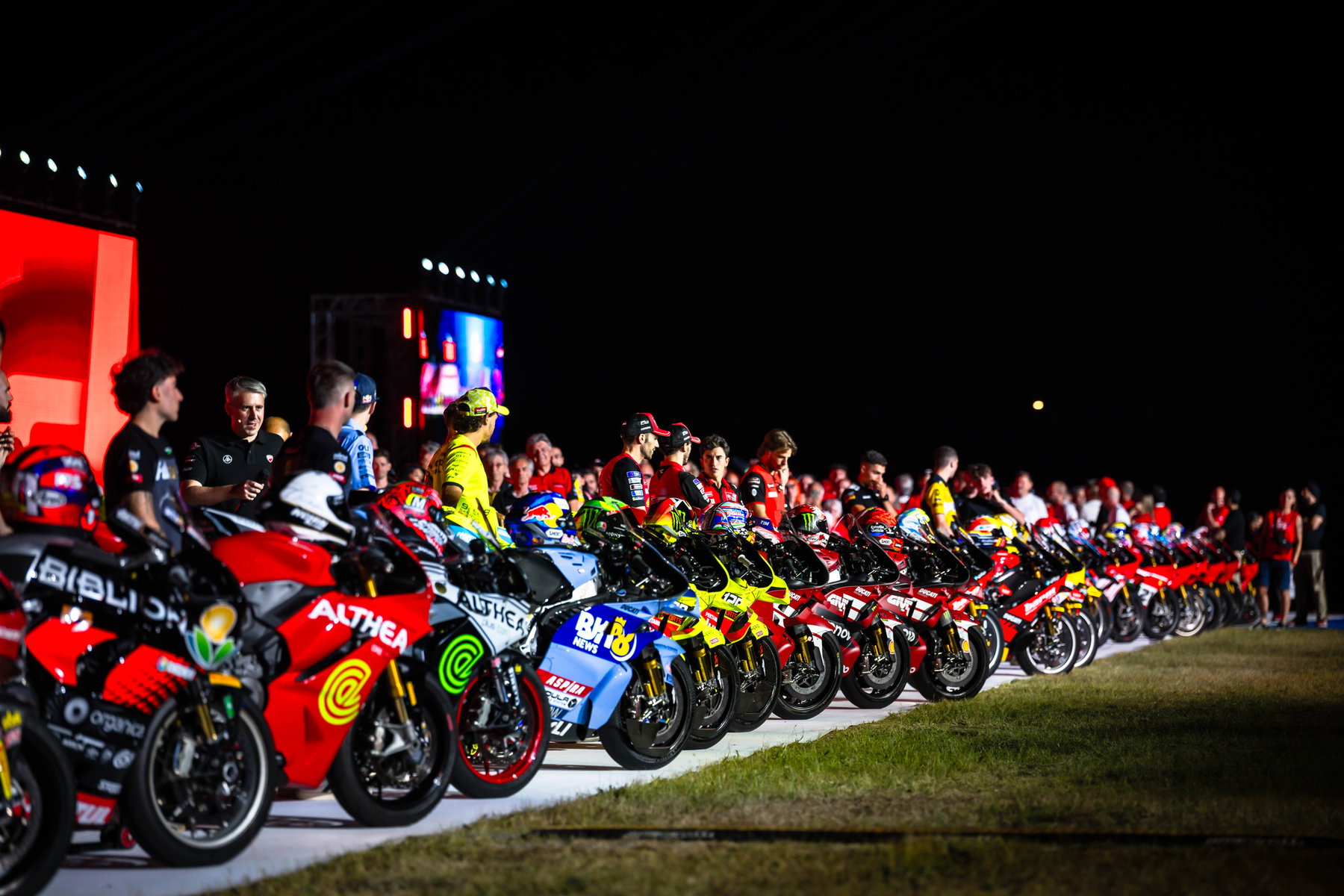
The occasion was the presentation of the exhibition „Ducati 100 – A Century on Display” at the Palazzo d’Accursio, in other words in the same building to which the mayor invited the unions a few days later. The show is part of the brand’s centenary. Domenicali described the company there as „very healthy and solid” and said he did not see a „particularly complicated horizon” for Borgo Panigale.
What changes for Ducati riders?
Nothing in the short term. Model updates, the dealer network and the racing programme continue unchanged, and the anniversary year is being seen through.
The starting position has changed nonetheless. A profitable brand with a hundred years of history now has to justify itself for not being needed by a car business. A sale would therefore not be a distress sale, but the opposite: Ducati is interesting precisely because the brand can be turned into cash easily when the group needs liquidity.
The episode thus fits into the development that has accompanied the Volkswagen Group throughout 2026. The restructuring is now reaching subsidiaries that give no cause for concern in business terms. Whether a new owner would continue the development budget, parts supply and MotoGP programme in this form, nobody is saying so far. That question will only be answered once it is clear whether a sale happens at all.
Frequently Asked Questions
-
Has the Ducati sale in 2026 been decided?
No. In both interviews, Audi boss Gernot Döllner explicitly stated that nothing has been decided. Ducati still belongs 100 percent to Audi AG, and there is no bidding process or official sale mandate.
-
Why is Ducati under review at all?
Volkswagen is reviewing around 600 of some 2,000 holdings and wants to streamline the portfolio by a third. The yardstick is the principle of necessity-to-own: holdings only stay if they are strategically, operationally or legally necessary for the core automotive business. A motorcycle manufacturer meets that criterion only with difficulty.
-
How much is Ducati worth?
Bloomberg Intelligence estimates the enterprise value at around 1.25 billion euros (about 1.46 billion US dollars). The only known offer so far, at 2.5 billion euros (around 2.91 billion US dollars), is roughly twice as high, but comes from a previously unknown company and has still not been backed by proof of funds.
-
How much revenue does Ducati generate?
In 2025 revenue stood at 925 million euros (around 1.08 billion US dollars) and operating profit at 52 million euros (around 60.6 million US dollars). Return on sales was 5.6 percent after around nine percent the year before, and deliveries fell to 50,895 motorcycles.
-
What role does the Italian government play?
Industry minister Adolfo Urso has announced that he intends to use all available means and has already spoken to Ducati’s leadership by phone. The region, the city of Bologna and the metalworkers’ unions have also become involved. A buyer would therefore need not only capital but also political backing in Italy.